Saturday, March 14, 2015

2 Gingers Irish Whiskey

A few things about this Irish Whiskey Blend

2 Gingers is somewhat of an interesting Irish Whiskey. It was produced, developed and branded from the imagination of Kieran Folliard, a Minnesotan Irishman. Whether that means he's an Irish immigrant, or just an American with Irish background, I don't know. I don't totally understand how we new worlders all classify ourselves, so I'll just throw that tidbit of information into the air, and you can catch the confetti and form your own theory. Or you know, you can Google it too. I'm sure that may turn something up.
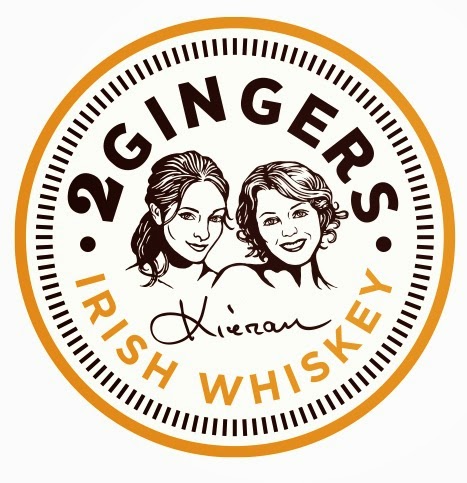
The logo baring the faces of the brand's inspiration.

In any case, it's a blended Whiskey imagined by Mr. Folliard, who wished to have his own alternative to rising demand and cost of Jameson's Irish Whiskey. The result is this blended whiskey from the Kilbeggan Distilling Co (owned by Beam Suntory). He named it after his mother and aunt, who he claims as the contributing push for him to follow through with his idea. The bottle bares a logo with their likenesses, and of course is called 2 Gingers, after the two red headed women.

2 Gingers was originally released in Minneapolis, Minnesota, where Mr. Folliard's bar took to using the product in their signature drink Big Ginger. In the fashion of putting hi-balls on the back of bottles and claiming a revolution, the drink consists of nothing more than the Whiskey and ginger ale, garnished with a lime and lemon wedge. Weaksauce!

Despite the previous point, I quite like the branding of this product, and particularly like the 2 Gingers motto "Bring your own luck!"
On to 2 Gingers Irish Whiskey


I already mentioned that I love the branding of this product, I also quite like how the sleek logo looks on the bottle, as well as the color of the inner contents. It's a very modern looking bottling, which I can appreciate. Nevertheless, I have to remind everyone that I don't give any points for branding, but merely for the contents of the bottle.

This is how most Tasting Notes reviews start out.
My favorite part of the process!
The nose is a delicate vanilla wood, and smells strongly of caramel. Baked bread, and a hint of anise are present. I have to reiterate the delicate nature of the nose. While rather pleasant it is quite soft,
and takes some time to notice. It falls a little flat of expectations with the great branding of the product. The nose carries through to the palette, not offering a whole lot more in taste. There is a hint of lemon and lime, over top a layer of sourness. It's a typical Irish Whiskey, of perhaps lower quality than Jameson, but not unpleasant. It has a certain level of dry acidity that is somewhat undesirable. In combination with the lackluster palette, it has a light level of rancidness that is noticeable in more than a few other middle quality spirits.

The finish is short lived, but the flavor comes out more in this portion of the tasting. A short burst of flavor as the fumes escape your palette, I suppose. It leaves no bad impressions, but does not have a vibrant depth of flavor that you would hope for. Oak wood tannins, and vanilla are the big players here, complementing the characteristic caramel flavor that was there throughout the tasting.

79/100

Friday, March 13, 2015

Daily fruit, both unnecessary and unhealthy

As a fan of Tim Ferris, I recently purchased and have been reading the 4 Hour Body. Again, as a fan, I've taken his advice at face value and gone ahead and followed through with his suggestions. One such suggestion that I'll be focusing on is that fruit is not necessary in your diet and can even cause more problems (eg. Weight gain) than its worth.

For ages now, people ha e contended that fruit is necessary because of vitamins that you can't get elsewhere. This theory has recently been extended to include antioxidants as well. A trip to the grocerystore, or a quick Google search will reveal the vitamin issue to be flat out wrong. Three cups or spinach for example, has almost all the Vitamin A you could need, while broccoli makes up the small amount of missing Vitamin C. As for B complex, you can get them from a host of different foods, some of which include beans, mushrooms, seafood, and collard greens. It seems that the common scare tactics involving pirates with scurvy can be attributed to a misunderstanding of exactly how limited those people's diets actually were.


So how about antioxidants? Aren't fruit the king in that domain? Well yes... that is, specifically berries are the best source of antioxidants. According to Canadian Living, the next four best sources however are brocolli, garlic, green tea and tomato. I would add that while tomato is a fruit, it is one of the few juicy seed sacks that's allowed on the diet. That being said, the science is still not in regarding the benefit of antioxidants, and studies appear to have mixed results, as this page from Harvard Health explains "One study even showed that taking beta-carotene may actually increase the chances of developing lung cancer in smokers." All in all, the benefit of antioxidants seems mostly to be caused by media sensationalism.


So what's the main difference between fruit and vegetables? Well, as it turns out, vegetable is not even a classification that carries any scientific weight, so our preconceptions about food may already be up for grabs. Nevertheless, I suppose we can arbitrarily define vegetables as any plant food that is either a leaf, stalk, flower, or root. Although, I know even that definition is not particular enough, we will not get lost in technicalities. The difference is sugar. You can basically think of the shell of the fruit as being like a placenta, or an egg shell, with the flesh being an energy source for the new life in the center. Fructose the sugar commonly found in fruits gets stored as far with amazing efficiency. In fact, more efficient than any other sugar.

For the above reasons I've cut fruit and its juice from my diet completely. Not only does it have alternatives, but it can also make you fat. I suppose the idea that it is helpful comes from the double pronged fact that fruit have nutritional value, with the falsehood that we need a little bit of everything but in moderation.


As an alcohol enthusiast, this causes little problem. Most of my cocktails are classics, if I'm not drinking my spirits neat. On the other hand, when I do opt for cocktails with juice, it can be fit into my carefully calculated cheat days (I know what all you other hardcore health nuts and dieters are thinking, and to that I respond: read his book!) As a bartender it causes even less strife, because I honestly don't care what someone's tastes are. If anything, I'm more happy when people know what cocktails they like.

Sunday, March 8, 2015

George Dickel No. 12 Tennessee Whisky

A few things about Tennessee Whisky

The definition of Tennessee Whisky is a hotly debated subjected in certain corners of the internet, and this blog is one such corner. The sides have been split between what is essentially the Jack Daniel's and George Dickel teams. Jack Daniel's argues that a strict definition and standard is
required for Tennessee Whisky to reach the same kind of international recognition as Scotch or Champagne.

The counter argument by the Dickel side is that strict regulations hinder creativity and the ability for the smaller brands to compete. Jack Daniel's responds once more stating that Dickel, owned by Diageo, who has many Scotch and Bourbon holdings has a vested interest in keeping the standards of quality for Tennessee Whisky inconsistent.

I tend to side with the Jack camp, but for different reasons. I think that Tennessee Whisky makers already have categories at their disposal if they want to stray from the formula that Jack Daniel's created so long ago. Bourbon has already had its regulations loosened, and in my opinion that's good enough. There is also the option for alternate categories, which those who stray from the standard employ; Ole Smoky's Tennessee Moonshine for example. And even Jack Daniel's has produced whiskey which it has branded under different labels, such as Tennessee Rye.

That being said, it is my opinion that George Dickel has a superior flagship product. George Dickel is everything you could ask of a standard quality American whiskey.

On to George Dickel No. 12


Starting with the bottling, it comes in a recognizable shape similar to Buffalo Trace, but has no rounded edges, a trait it shares with the other major Tennessee Whisky producer. The layout of the label, with similar fonts and placement also suggests some sort of kinship with Jack Daniel's. There is
(Dickel is a mainstay for some classic whiskey cocktails.)
no relstion, however. Dickel was a German immigrant who came to America and decided to start making whiskey, but, it may be somewhat obvious that he was inspired by Jack. He had some ideas of his own, though, beginning with the 90 proof bottling.

The nose stings at first, but the odor of corn and maple caramel push through the higher alcohol content. Decanting with a few drops of water releases notes of vanilla, citrus peels, damp wood and oak. The palette is a smooth transition from the notes in the nose, with the corn front and center, but it feels oddly like an Islay Scotch with smoke and peat presence. The whiskey takes on a sweet and sour characteristic, which is an interesting dynamic.

The finish is quite long, with vanilla and corn throughout the entire experience. Musky wood, and menthol tobacco are present, and the tobacco lingers with a hint of smoke. It's not bad in the way that cigarette smoke is, but leaves an impression of old timers packing their pipes.

82/100

Friday, March 6, 2015

How to Make the Hanky Panky Cocktail


In 1925 Ada Coleman of the Savoy Hotel blessed the world with the Hanky Panky. This time on The Bottle Opener, we walk in the footsteps of the Toronto and the Fanciulli yet again, for another timeless Fernet classic. The cocktail was made for and dedicated to Sir Charles Hawtrey, who also named the cocktail, commenting that it was "the real hanky panky."

Unlike our previous Fernet cocktail, this one calls for gin, rather than whiskey. I went for the Yukonshine Auragin - top rated Canadian craft gin, featuring powerful grapefruit notes. Many bartenders suggest to use a higher quality vermouth such as Punt e Mes, though, I feel that Martini is a good and flavorful product, with cheap price point.

The Hanky Panky
  • 1 1/2 oz Dry Gin
  • 1 1/2 oz Sweet Vermouth
  • 1 TSP Fernet Branca 
  • Garnish with orange peel twist
Combine ingredients in a mixing glass, stir, and strain into a chilled glass. Top it off with your orange peel and always remember, enjoy!

Sunday, March 1, 2015

How to Make a Fanciulli Cocktail


Obscure classic cocktails with one ingredient that makes it stray from the mainstream are somewhat of a Forte for me. That seems to be the case lately at least. And who am I to deny the greatness of obscure classics? Much like the classic automobiles, cocktails of yesteryear seem to have an air of elegance about them. They manage to pull off this perfect combination of style and practicality which has been lost in history until recently. At times they portray rustic simplicity and at other times flamboyant post modernism. They seemed to disappear with the rise of vodka and hi-ball culture, but have been making a come back with the return of the small business and craft artisan scenes.

(You'll need some version of these to make a Fanciulli.)
This brings us full circle to the Fanciulli, like the Toronto, a whiskey cocktail featuring Fernet Branca. Where it differs from the Toronto is that like a Manhattan, it is cut back by sweet vermouth rather than simple syrup. Unlike the Manhattan, Fernet plays stand in for Angostura bitters. The results are fantastic. A Manhattan with a menthol kick to the jowels. When you make it, make sure to use a whisky that can go toe to toe with fernet.

Like many cocktails of the time, the origins are fuzzy. It first appeared in print in 1935, in Old Waldorf Days, where Albert Stevens Crocket references an origin earlier than 1910, and the name being Italian slang for "the boys". Another origin story credits the name to Francesco Fanciulli, who led the US Marine Corps band in the 1890s. The Straight Up, reports that Fernet 's abrasiveness earned the cocktail the name, after Fanciulli who was argumentative and eventually court-martialed. Fanciulli was the successor of John Phillip Sousa, and so struggled to stand up to the shadow of his predecessor.

Whatever the case, the cocktail possesses that magical charm that many classics do. Fernet works wonders on the palette time and time again, and the Fanciulli is another addition to the list of obscure greatness from the late 1800s and early 1900s. It's somewhat of a misfit cocktail, and so I recommend indulging in a misfit way; sans garnish and in a glass too tall.

The Fanciulli
1 1/2 oz Whiskey
1/2 oz sweet Vermouth
2 dashes of Fernet Branca 
 
blogger widget